The Archipelago’s Black Gold: A Narrative of Character Over Quantity
This is the story of the "Black Gold" from the Nusantara. A story proving that in the vast world of coffee, Indonesia does not chase quantity; it chases character.
If Brazil is the world’s coffee "factory," and Vietnam is the world’s caffeine "battery," then Indonesia is the world’s "Flavor Boutique."
Here is the untold story of the uniqueness of Indonesian Arabica:
The Heavyweight Champion: The Sexiest Body in the World
In the eyes of global coffee connoisseurs, Indonesian Arabica holds a legendary reputation that no other country can replicate: Body.
While Central American coffees offer a tea-like lightness and acidity, Indonesian Arabica (specifically from Sumatra and Sulawesi) arrives with a texture that is thick, viscous, and creamy—a sensation known as mouthfeel. If we compare it to wine, while others are light white wines, Indonesian Arabica is the heavy, full-bodied red wine of the coffee world.
The secret? Wet Hulling (Giling Basah). This is our ancestors' "secret weapon." Due to the tropical humidity and heavy rainfall, our farmers cannot dry the beans completely like in Africa. They hull the parchment while the beans are still wet.
The Result: Jade-colored beans that produce an intense earthy profile, rich with spices, and low acidity. This flavor profile cannot be replicated, even by the most advanced machinery in Brazil.
Unity in Diversity: A Symphony in a Cup
The greatest uniqueness of Indonesian Arabica is its Terroir. As an archipelago sitting on the Ring of Fire, every island boasts a different volcanic soil composition, creating flavor profiles that contrast sharply with one another:
- Sumatra (Gayo & Mandheling): The King of Spice. The most famous Indonesian coffee. Its aroma punches through with notes of dark chocolate, tobacco, cinnamon, and the damp rainforest floor. This is a mandatory component in expensive Italian espresso blends and Starbucks Reserves to provide that "kick."
- Sulawesi (Toraja Kalosi): The Elegant Aristocrat. Grown at extreme altitudes in Toraja. The taste is deep, complex, with notes of caramel, ripe fruit, and spices that are far more refined than its Sumatran cousin. Often cited as one of the most sophisticated coffees in the world.
- Bali (Kintamani): The Tropical Refresher. Unique due to the intercropping system with orange trees. Kintamani Arabica possesses a distinct citrus aroma and a sweeter, lighter body. It is a refreshing anomaly among the usually "heavy" Indonesian coffees.
- Java (Preanger/Ijen): The Historical Legend. In America, the word "Java" simply means coffee. This is the legacy of history. Java coffee (especially West Java/Preanger) is making a comeback with a sweeter profile, fruity aromas, and balanced acidity.
Why is it Expensive and Sought After?
If you wonder why commodities related to specialty coffee are attractive, look at these facts:
Scarcity: Only 10–15% of Indonesia's total production consists of Arabica. The rest is Robusta. The supply is limited, but the global demand is massive.
Strong Identity: On the New York exchange, Indonesian coffee often commands a premium price because it is used as a blender to inject soul into cheaper coffees from other nations. Brazil provides the volume; Indonesia provides the spirit.
The Investment Paradox
But after all, despite this richness of history, the complexity of flavors, and the global dominance of Indonesian coffee, there is an ironic reality facing investors today.
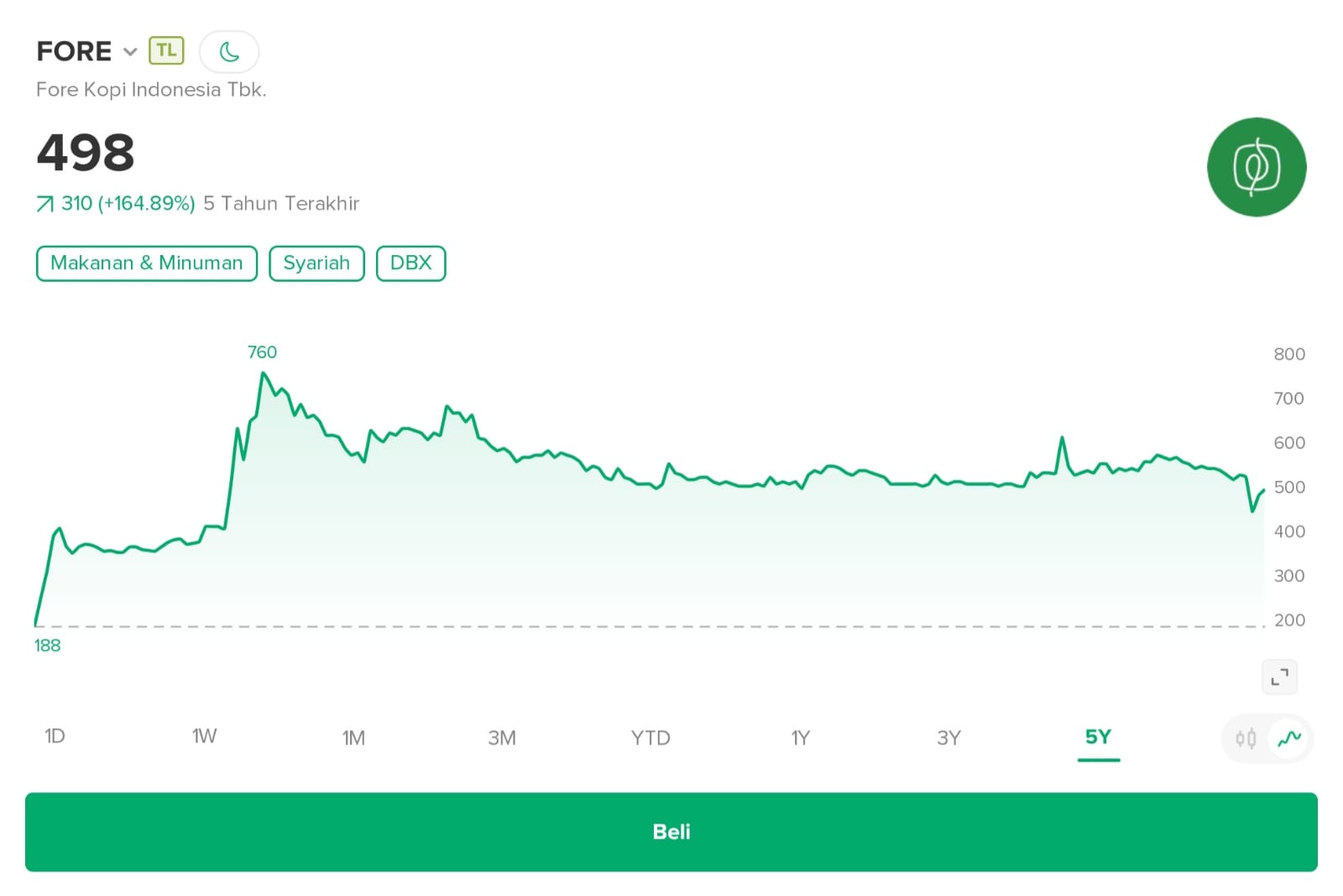
If you want to own a piece of this "Black Gold" through the capital market, your options are incredibly limited. As of today, there is only one issuer related to coffee listed on the Indonesia Stock Exchange: Fore.
This scarcity explains the financial anomaly we are seeing. Investors are flocking to Fore not just because of its tech-enabled business model or its aggressive expansion, but because of scarcity value. It is currently the only proxy for the Indonesian coffee consumption story in the public market.
Consequently, Fore commands a relatively premium valuation. The market is willing to pay a higher price (high P/E or EV/EBITDA) simply because there is no second option. It is the only ship sailing in a sea of liquidity that wants exposure to the Indonesian coffee lifestyle. Until another challenger enters the ring, Fore remains the exclusive gateway to this lucrative sector, justifying its premium price tag in a market hungry for the real 'Nusantara' experience.