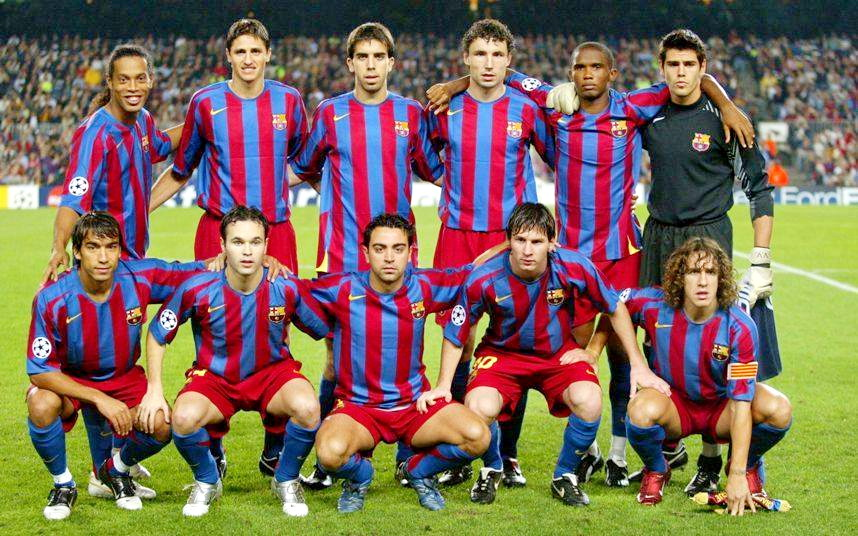
Part 2 of 3: From the Blank Jersey to Qatar Airways — FC Barcelona's Commercial Pivot and the Bartomeu Catastrophe
This is the second in a three-part series. Part 1 examined the democratic foundations of FC Barcelona. This instalment traces the club's sporting peak in 2009, its first commercial compromises, and the financial collapse of the Bartomeu era.
By the 2008–09 season, FC Barcelona had arrived at what many observers would later identify as the high-water mark of the club's modern history. Under their first full season with Pep Guardiola, the team was dismantling opponents with a consistency and aesthetic clarity that the sport had rarely seen — a style of play that would soon be given a name the entire football world would recognise: tiki-taka.
The philosophy was not new. Its roots ran back through Johan Cruyff's revolutionary tenure as manager in the late 1980s, through the La Masia academy that had been quietly producing technically refined players for three decades, and through a Catalan football culture that had always prized intelligence and movement over physicality. What Guardiola did was distil all of that inheritance into its most concentrated form. His Barcelona pressed as a unit when out of possession, suffocating opponents high up the pitch. In possession, they moved the ball with a speed and precision that made structured defensive systems look helpless — not because of individual brilliance alone, but because the collective was always a step ahead of what any defence could anticipate.
The numbers from that season speak to the dominance. Barcelona scored 105 goals in La Liga alone, conceding just 35. In the Champions League, they struck 18 goals in the group stage before dismantling Olympique Lyonnais (6–3 on aggregate), annihilating Bayern Munich 4–0 in the first leg of the quarter-finals at Camp Nou, and then surviving a brutal semi-final against Chelsea — decided only by Andrés Iniesta's extraordinary goal in the final seconds of the second leg.
The climax came on May 27, 2009, at the Stadio Olimpico in Rome. The Champions League final against Manchester United — the reigning European champions and one of the most powerful clubs in the world at the time — should have been a contest. It was not. Barcelona were imperious. Samuel Eto'o opened the scoring in the 10th minute, and Lionel Messi headed in the second from a Xavi cross on the 70th minute to seal a 2–0 victory and complete the first treble in Spanish football history — La Liga, Copa del Rey, and Champions League, all in a single season.
The Rome final was not merely a sporting achievement. It was the culmination of an institutional philosophy: a playing squad built almost entirely through an academy, coached by a man who had himself come through that same system, playing football that expressed values — collective intelligence, technical excellence, relentless pressing — that reflected the club's identity. It was the moment when the La Masia project and the Més que un club ethos felt most completely realised on a football pitch.
That coherence between institution and performance, however, would prove difficult to sustain. The commercial pressures that followed would test whether the model that produced the 2009 generation could survive the decade ahead.
The Sporting Peak: Guardiola's System and the 2008–2012 Generation
Pep Guardiola was appointed first-team manager in June 2008. He had been a Barça player and Barça captain, and his tactical vision was a direct extension of the Johan Cruyff philosophy that had shaped La Masia for three decades. His system demanded extreme positional discipline, relentless pressing, and a fluid 4–3–3 formation that could morph in possession into a 3–4–3 or a 2–3–5.
The squad he inherited was built almost entirely on academy graduates. Xavi Hernández, Andrés Iniesta, Víctor Valdés, Sergio Busquets, Pedro, Carles Puyol — all products of La Masia. Lionel Messi himself, though born in Rosario, Argentina, had arrived at La Masia at the age of 13 in 2000, when the club agreed to fund his growth hormone treatment, and was as much a product of the academy as any player who grew up in Catalonia.
Between 2008 and 2012, this team won an extraordinary sequence of trophies:
- 3 La Liga titles (2009, 2010, 2011)
- 2 UEFA Champions League trophies (2009, 2011)
- 2 Copa del Rey titles (2009, 2012)
- 2 FIFA Club World Cups (2009, 2011)
The 2009 team did not merely win — it established a tactical grammar that influenced a generation of coaches globally, from the Spanish national team's 2010 World Cup triumph to Guardiola's subsequent work at Bayern Munich and Manchester City. Journalist Martí Perarnau, who chronicled Guardiola's methods closely in his book Pep Confidential, argued that what Guardiola built at Barcelona was not just a trophy-winning machine, but living proof that a patient, philosophy-driven approach to football — built through an academy over decades — could consistently defeat the world's best.
The Blank Jersey: 107 Years of Commercial Restraint
To understand the significance of what came next, it is worth pausing on what Barcelona had been for the previous century. From the club's founding in 1899 until 2006 — for 107 years — FC Barcelona had operated without a commercial shirt sponsor. The blue and claret (blaugrana) stripes were considered institutionally "sacred" — a visual marker of the club's identity as a member-owned institution that did not exist to generate returns for an external corporation.
This was not merely symbolic. It was financially significant. The club was, in effect, sacrificing tens of millions of euros per season in potential sponsorship revenue — a luxury that was only possible because the socio model provided stable membership income and the La Masia production line kept transfer spending modest. By the time Guardiola's team were winning the treble in 2009, the UNICEF logo had already been on the shirt for three seasons — the first break in that 107-year tradition, and one that, as the next section explains, was only the beginning.
The Humanitarian Pivot: UNICEF (2006) and the First Compromise
The first departure from the blank jersey occurred in 2006 under President Joan Laporta. Laporta's innovation was to frame the move not as commercialisation but as its opposite. Barcelona agreed to wear the UNICEF logo on their shirts — but instead of receiving money from UNICEF, the club paid UNICEF, pledging to donate a minimum of €1.5 million annually (later raised to €2 million) to support global child welfare projects.
The move was politically brilliant. Traditionalists who might have objected to a corporate logo could not easily object to the United Nations Children's Fund. Critics who might have accused the board of selling out could not accuse them of profiting. The club positioned itself as "the club for the children of the world," reinforcing the Més que un club ethos in a new, globally legible way.
But there was a longer-term institutional consequence that commentators only recognised in retrospect: the UNICEF deal broke the psychological taboo of a logo appearing on the shirt. It prepared the socios — gradually, gently — for what was coming next.
The Commercial Slippery Slope: Qatar Foundation and Qatar Airways (2010–2017)
By 2010, the financial landscape of European football had shifted dramatically. The English Premier League's television rights deals were generating revenues that La Liga clubs could not match. The emergence of state-backed clubs — most critically, Manchester City (acquired by Abu Dhabi interests in 2008) and Paris Saint-Germain (acquired by Qatar Sports Investments in 2011) — created a new category of competitor unconstrained by the economics of self-sustaining clubs.
Under President Sandro Rosell, Barcelona signed a landmark deal in December 2010 with the Qatar Foundation, a non-profit organisation aligned with the Qatari government. The deal, worth €30 million per season, made the Qatar Foundation logo the first paid commercial sponsor to appear on a Barcelona shirt — ending the 112-year tradition of commercial abstinence.
The institutional debate was fierce. Critics pointed to Qatar's human rights record and the conditions facing migrant workers in the country. Rosell's counter-argument, widely reported at the time, was pragmatic: he acknowledged his personal preference for a blank shirt, but maintained that the club could not sustain its competitive position without the income — and that staying financially competitive was itself a form of protecting the institution.
By 2013, the non-profit Qatar Foundation had been replaced on the shirt by the purely commercial Qatar Airways, further eroding the moral framing of the original deal. Despite sustained criticism, the majority of the socios' delegate assembly ratified both transitions, prioritising financial competitiveness over historical tradition.
The commercial trajectory was now established. The blank jersey was gone. The humanitarian justification was fading.
The Bartomeu Era: A Study in Institutional Failure (2014–2020)
The presidency of Josep Maria Bartomeu, who assumed office in January 2014, represents the most damaging period in the club's recent institutional history. On the pitch, the early years were spectacular: the club won the treble in 2015 — La Liga, Copa del Rey, and Champions League — under manager Luis Enrique, with a forward line of Messi, Neymar Jr., and Luis Suárez that generated 122 goals in a single league campaign.
Off the pitch, however, the financial governance was deteriorating toward catastrophe.
The Neymar Effect and Panic Spending
When Neymar Jr. departed to Paris Saint-Germain in August 2017 for a world-record fee of €222 million, it created a structural crisis in the club's transfer logic. Rather than accepting that PSG had simply paid an unsustainable price, the Barcelona board responded by attempting to replace him with a series of high-profile, high-cost acquisitions — none of which justified their fees.
| Player | Transfer Fee | Outcome |
|---|---|---|
| Philippe Coutinho | €160 million | Underperformed; eventually sold at a substantial loss |
| Ousmane Dembélé | €148 million | Repeatedly injured; bonuses easily triggered |
| Antoine Griezmann | €120 million | Poor cultural fit; sold back at a significant loss |
| Lionel Messi (2017 Contract) | €555 million (total value) | Unsustainable; ultimately led to his departure in 2021 |
Transfer fees via Transfermarkt; Messi contract total value as reported by El Mundo (January 2021)
The logic driving these acquisitions was circular: the club needed to win to generate revenue, and needed to spend to win. But the spending was not calibrated to actual income — it was calibrated to anticipated income in a best-case scenario of continued Champions League success.
The Financial Reckoning
By 2021, the scale of the damage became public. Audit reports commissioned by the incoming Laporta administration revealed a picture of extraordinary severity:
- Gross debt: €1.35 billion
- Short-term liabilities: €730 million payable within 12 months
- Wage bill: 103% of total club income
That final figure is the most damning. The club was spending more on wages alone than it was generating in all revenue streams combined — matchday income, broadcasting rights, commercial partnerships, and merchandise. The COVID-19 pandemic, which had wiped out matchday revenues across the 2019–20 and 2020–21 seasons, removed the final cushion that had been masking this structural imbalance.
The 8–2: Sport as Institutional Mirror
The on-field expression of this institutional decay was the most humiliating result in the club's modern history: a 2–8 loss to Bayern Munich in the Champions League quarter-final on August 14, 2020 — played as a one-off tie at a neutral venue (Lisbon) due to the pandemic.
The scoreline was brutal, but what it revealed was worse. The 2020 team — Coutinho, Griezmann, an ageing defensive line, and a Messi who was visibly unable to carry the entire squad — was an expensive collection of individuals without collective identity. Compare this with the 2009 team, built through the academy, animated by a coherent philosophy, and capable of making an opponent of Bayern Munich's calibre look ordinary.
The 8–2 was not just a sporting result. It was an X-ray of an institution that had lost its values — both on and off the pitch.
Read Part 3: The Age of Levers — How FC Barcelona Mortgaged Its Future to Survive the Present
All sources for this three-part series are compiled at the end of Part 3.