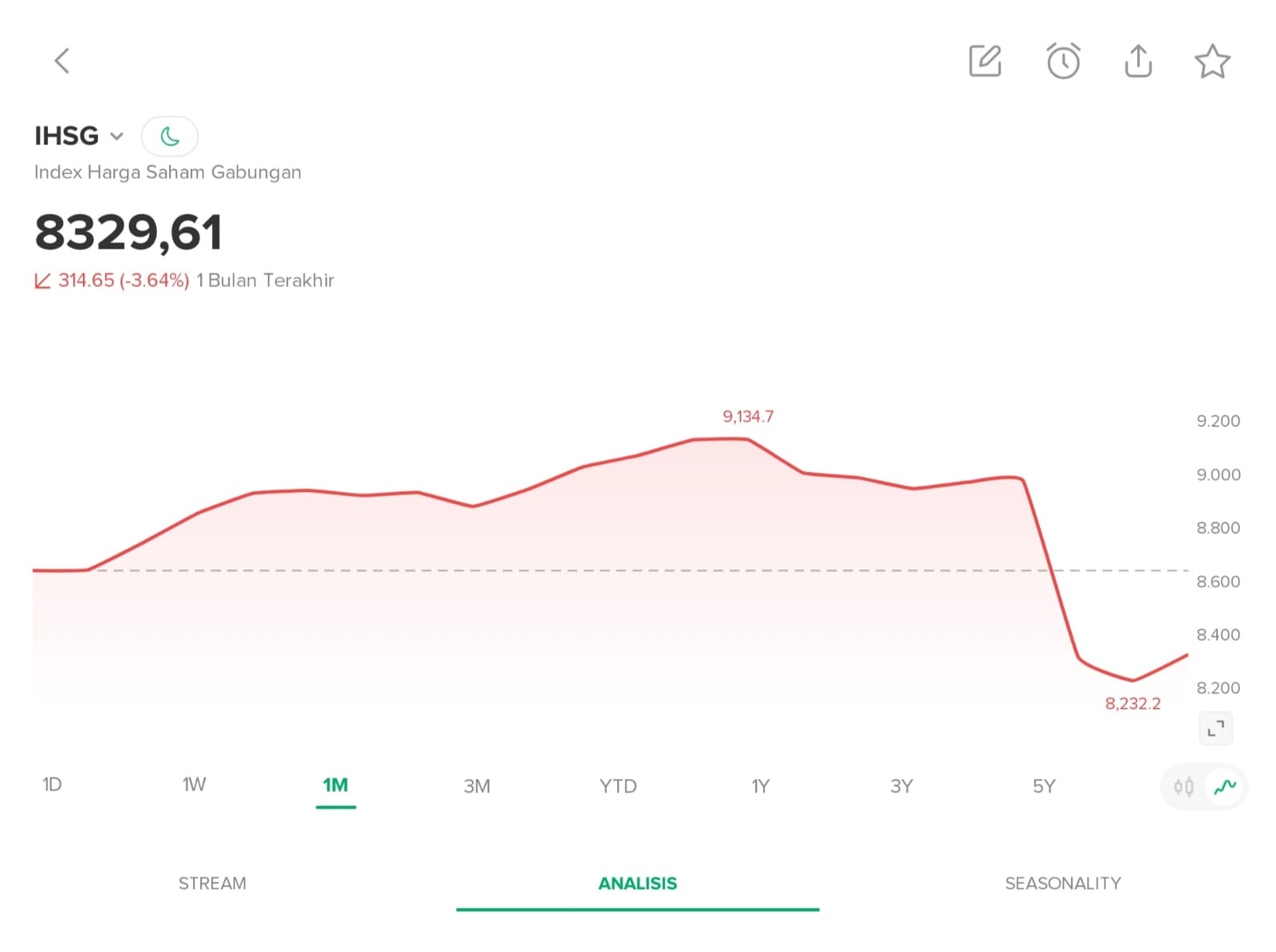
Understanding Today’s Sharp IHSG Decline: A Rational Guide for Investors
Today’s sharp decline in the IHSG may feel unsettling, especially for new investors still adapting to market fluctuations. Seeing a portfolio turn red simultaneously often raises concern. However, understanding the actual mechanics behind this drop is the first step toward becoming a confident and disciplined investor.
What Actually Happened?
Contrary to common belief, a sharp drop in a major index like the IHSG is rarely caused solely by stocks with weak fundamentals. The IHSG is a market-capitalization-weighted index, meaning it is heavily influenced by the largest companies (Big Caps or Blue Chips). Therefore, the main driver behind today’s significant decline was likely selling pressure on these heavyweight stocks. When institutional investors adjust their portfolios due to macroeconomic factors (such as currency fluctuation or global interest rates), they often reduce positions in liquid Blue Chip stocks first, dragging the entire index down with them.
The Domino Effect: Why Did Everything Fall?
When the "market movers" (Blue Chips) undergo a deep correction, it creates a negative psychological ripple effect across the entire market:
- Market Correlation: As the index drops, fear spreads. Retail investors often react by panic selling, not just their Blue Chips, but also their second and third-liner stocks to secure cash.
- Flight to Safety: Stocks with weak fundamentals (unstable earnings or high debt) are indeed riskier. During these times, they tend to fall even harder as investors rush to exit speculative positions.
Price vs. Value: The Opportunity in the Chaos
For beginner investors, it is crucial to understand that today’s price drop does not necessarily reflect a sudden failure in a company’s business operations. In the short term, the market acts like a voting machine driven by emotion (fear and greed).
- Price is what you pay today, which may be discounted due to negative market sentiment.
- Value is the company’s long-term ability to generate profit. Fundamentally strong companies that declined today are likely experiencing temporary mispricing. For experienced investors, this is often seen not as a crisis, but as a "discount" opportunity.
A Lesson in Portfolio Quality
This market movement offers a critical lesson in risk management. While all stocks may fall during a panic, they do not all recover at the same speed. Companies with weak fundamentals may struggle to bounce back when the market recovers. In contrast, companies with strong fundamentals, healthy cash flow, and good management usually have the resilience to recover and reach new highs once the storm passes.
Conclusion
For long-term investors, market declines like this should not trigger panic. Instead, use this moment to review your portfolio: "Do I own solid businesses, or was I just speculating?" Volatility is the "admission fee" for stock market returns. By staying calm, ignoring the noise, and focusing on the long-term value of the companies you own, you can navigate these corrections wisely.